How eToro's Fees Affect Your Investment Returns
- No deposit fees
- No account management fees
- No fees to open an account
- Commission-free for real stocks and ETF trading
- Transparent fee structure
52% of retail CFD accounts lose money.
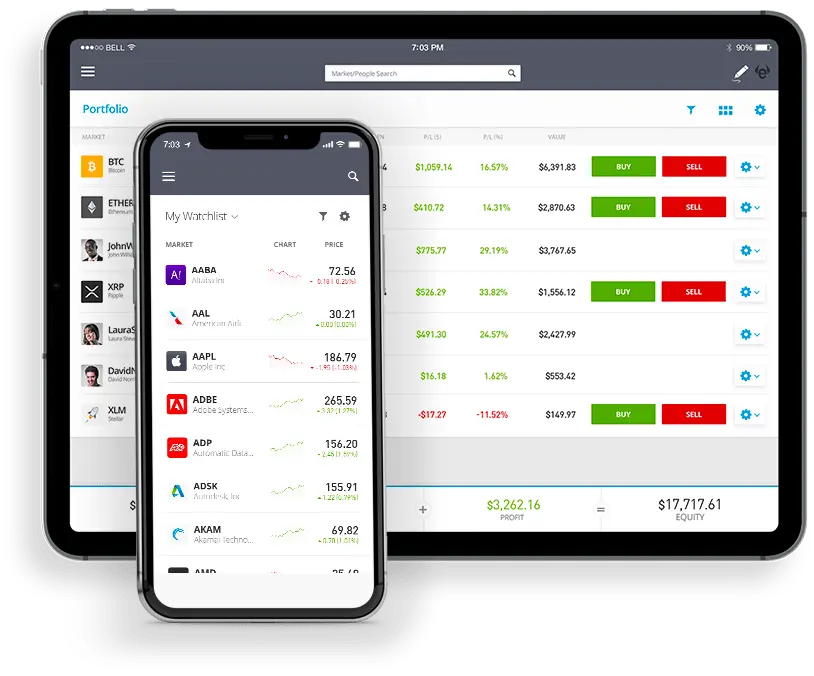
Trading via eToro's platform involves various fees, including spreads, withdrawal fees and overnight fees. Such fees can have an effect on your investment returns.
Now if you want to get the best out of your profits, you need to know exactly what you’re paying for.
Let me break these charges down so you'll know what to do:
The spread is the built-in cost of every trade—the difference between the buy (ask) and sell (bid) price of an asset. eToro bakes this into the price itself, so you won’t see it as a separate charge.
For example, major forex pairs like EUR/USD typically have a spread of 1 pip, while stock trades come with a 0.09% spread based on the trade value.
Thinking of trading Bitcoin or Ethereum? eToro charges a 1% fee on every crypto trade—both buying and selling. This is automatically included in the market price when you enter or exit a cryptocurrency position.
Every withdrawal comes with a $5 fee so withdrawing larger amounts, less frequently, can save you some cash. The minimum withdrawable amount is $30.
So, for example, why make two withdrawal transactions of $50 when you can simply cash out $100? That alone saves you $5!
Since eToro operates in USD only, any deposits or withdrawals in other currencies will be converted at a cost.
For instance, converting GBP to USD via bank transfer incurs a fee of 50 pips (roughly 0.4%).
Go radio silent for 12 months, and eToro starts charging a $10 monthly inactivity fee. The fix? Just log in once in a while to avoid it.
Holding a leveraged position overnight? Expect to pay an interest fee based on the asset and position size.
For instance, a $1,000 leveraged position in a U.S. stock could rack up $0.22 per night in fees.
Personally, I think that these are not that costly but if you add them up, especially if you trade frequently or hold positions long-term, then that's a totally different story. You need to factor them in and plan accordingly in order to maximize your returns.
 About Nadav Zelver